

 12 minutes read
You're probably deciding whether to keep a task-focused administrative assistant or pay for an executive assistant who can protect a partner's time, screen judgment calls, and handle sensitive communication without constant supervision. That distinction matters because firms don't get burned by titles, they get burned by mismatched scope. A strong admin can keep a busy office moving, but an executive assistant is a different purchase. You're buying decision rights, tighter confidentiality exposure, and a person who can work inside one leader's priorities instead of a department's workflow.
For U.S. law firms, the cleanest way to think about the difference between administrative assistant and executive assistant is not seniority. It's whether the role is built for routine execution or for trusted coordination around one principal. That shows up in who the person supports, how much inbox and calendar control they have, whether they can draft on behalf of a partner, and how much judgment they're expected to use when nobody is looking over their shoulder. The rest of this guide gives you a practical way to tell the roles apart, budget for each one, and decide when a firm needs the higher tier.
| Dimension | Administrative Assistant | Executive Assistant |
|---|---|---|
| Daily focus | Routine office and clerical support, scheduling, filing, data entry, document prep | High-trust coordination for one senior leader, calendar control, correspondence, meeting prep |
| Reporting line | Often reports to an office administrator or department manager | Typically reports directly to a senior executive or partner |
| Who they support | A team, department, or multiple managers | One principal, or a very small leadership group |
| Confidentiality level | Moderate, tied to office operations and ordinary matter handling | High, often including sensitive client, partner, billing, or leadership information |
| Decision rights | Follows established processes and escalates exceptions | Filters, prioritizes, and commits on the leader's behalf within defined guardrails |
| Best fit | When the work is repeatable and supervised | When the role protects time, communication, and judgment for a principal |
The most common mistake is treating this as a title upgrade. A firm sees “executive assistant,” assumes the person will magically solve partner overload, and then finds out the role was really just an admin with a fancier label. That's how you end up paying for premium support while still doing all the prioritizing yourself.
The better definition is blunt. An administrative assistant owns task execution, calendar entries, filing, travel bookings, document formatting, billing entry, and other repeatable work. An executive assistant owns information triage for one or two principals, which means filtering partner-level email, drafting correspondence in the partner's voice, managing attorney-client communications, and protecting the leader's time. The distinction is visible on a resume in the reporting line, the inbox ownership, and whether the candidate has supported a single principal rather than a whole floor.

Practical rule: if the person has to decide what gets in front of the partner and what gets pushed back, you're in executive-assistant territory.
That's the fingerprint hiring teams should look for. A strong admin can be excellent at keeping the machine running. A true executive assistant is trusted to run point on the leader's day, with enough autonomy to shield interruptions and enough discretion to keep sensitive information from bouncing around the office.
| Dimension | Administrative Assistant | Executive Assistant |
|---|---|---|
| Core responsibilities | Phones, documents, scheduling, data entry, front-office coordination | Executive calendars, confidential communications, meeting prep, gatekeeping |
| Primary support model | Team, department, office, or multiple managers | One senior leader, sometimes a small leadership cluster |
| Reporting relationship | Office administrator, department manager, or operational lead | Senior executive, partner, CEO, or other principal |
| Confidentiality and discretion | Standard office discretion | High-trust handling of sensitive, leadership-level information |
| Decision rights | Executes assigned tasks and escalates issues | Prioritizes, filters, and makes judgment calls within clear boundaries |
| Typical systems | Shared calendars, document management, phone systems, case or office software | Executive inbox, calendar tools, meeting packets, travel systems, leadership communications |
| Best-fit use case | You need dependable coverage for recurring office work | You need one person to protect a principal's time and communications |
A law firm usually needs both, just not for the same reasons. The admin keeps the office moving, the executive assistant protects the partner or practice leader from noise, conflicts, and schedule chaos. Routine work can overlap, and in a healthy office it often should.
Judgment should not overlap. A shared inbox, a court-date reminder, or a travel booking can move between roles without trouble. A call from opposing counsel, a sensitive client complaint, or a calendar conflict tied to a filing deadline should be handled by the person who has the authority and context to make the call correctly.
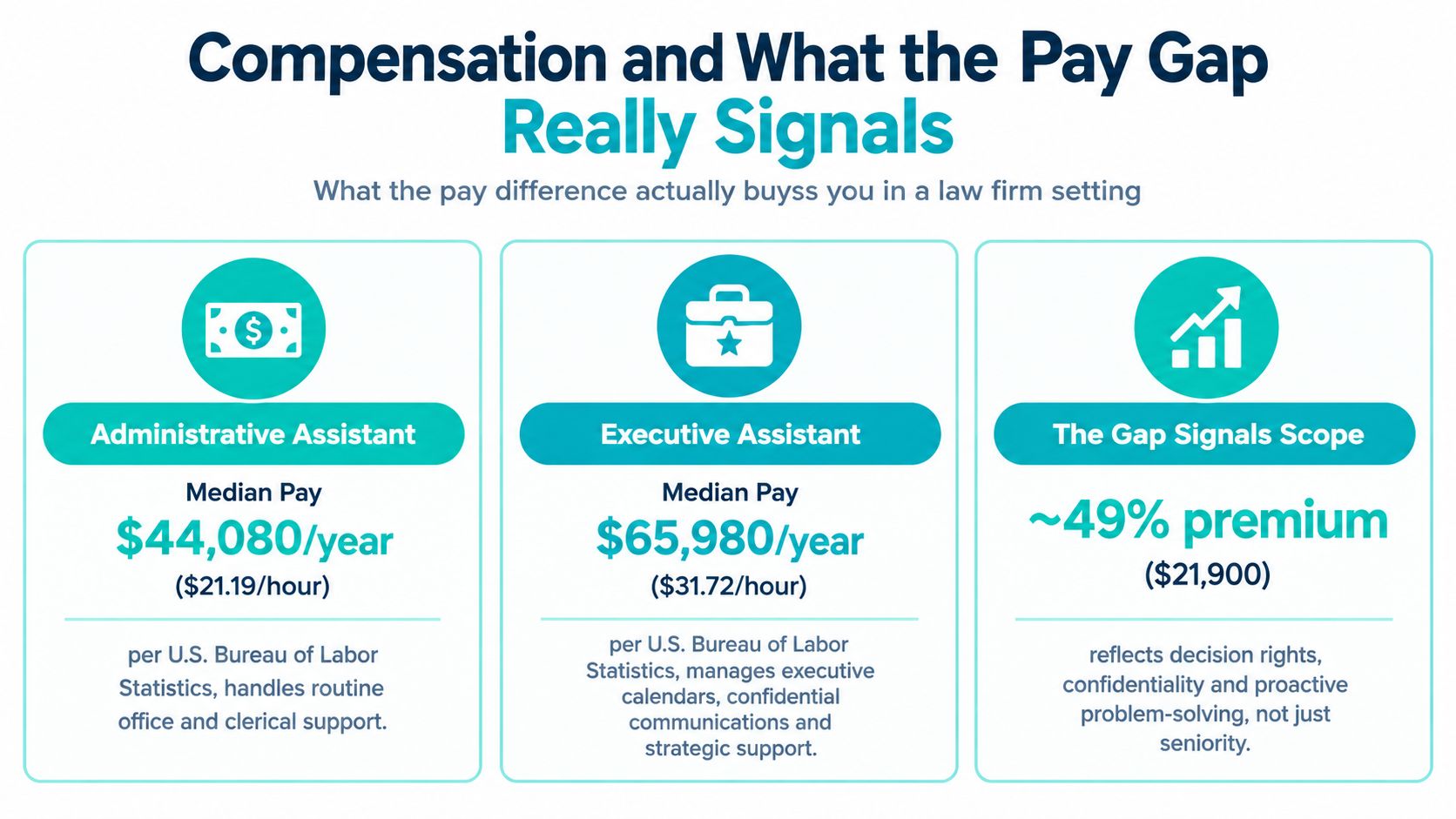
The U.S. wage data makes the hierarchy clear. The Bureau of Labor Statistics reported a May 2023 median annual wage of $70,310 for executive secretaries and executive administrative assistants, with the middle 50% earning between $56,960 and $84,860, while the broader secretaries and administrative assistants group had a May 2025 median annual wage of $48,310 (BLS occupational wage data). In a separate U.S. wage dataset, executive secretaries and executive administrative assistants had a 2025 median annual wage of $76,590, while a broader administrative-assistant category sat at $47,540, which the source frames as roughly a 61% higher median for the executive track (O*NET summary for 43-6011.00).
The pay gap exists for a reason. You're not just paying for more experience. You're paying for single-principal loyalty, after-hours responsiveness, confidentiality exposure, and the ability to make judgment calls around attorney time, client communication, and meeting priorities without dragging every issue back to the managing partner. That's why a real executive assistant often costs more than an admin who can cover a whole office.
If you're budgeting for a legal support hire, don't stop at wage data. A firm also absorbs recruiting time, onboarding time, and the cost of a wrong hire. A miscast executive assistant can frustrate partners and confuse staff. A miscast administrative assistant can bottleneck basic operations because the person is overqualified for task work but underutilized for strategic support. If you're comparing market rates, a clear pricing framework for legal staffing is more useful than guessing from title alone.
An effective administrative assistant is built around consistency. That person needs clean calendar control, document formatting, intake triage, billing entry, and comfort working inside established office procedures. In a law firm, that often means handling scheduling across multiple people, keeping matter documents organized, and making sure the front end of the office doesn't wobble when phones, emails, and filings all hit at once.
A true executive assistant looks different. That person should be comfortable gatekeeping, drafting partner-level correspondence, managing travel and board cycles, and working a week ahead without supervision. The work is less about volume and more about judgment. For firms, the most important signal is whether the candidate has supported a senior executive or equity partner and knows how to protect time instead of just fill it.
A strong executive assistant doesn't just keep a calendar. They protect the calendar from becoming a trash bin.
Here are the three screening signals I'd use in a law-firm interview. First, ask about discretion with sensitive matter information. Second, ask whether they've supported a C-suite executive or equity partner, not just a department. Third, ask for an example of pushing back on priorities when the leader's day was already overloaded. If they've never had to do that, they may be a very good admin, but they're not yet an executive assistant in practice.
| Dimension | Administrative Assistant | Executive Assistant |
|---|---|---|
| Main strength | Reliable execution | Trusted judgment |
| Experience pattern | Team support, office operations, shared scheduling | Senior-leader support, private inbox and calendar ownership |
| Communication style | Clear, accurate, responsive | Diplomatic, proactive, concise, leader-aligned |
| Work cadence | Follows the system | Anticipates next steps and organizes around priorities |
| Decision rights | Recommends and escalates | Commits within parameters and protects the principal's time |
The cleanest line is this, admins recommend, executive assistants commit. That difference matters inside a legal practice because one role can keep a process moving, while the other can make a partner's day workable.
A solo family law practice doesn't need an executive assistant just because the owner is busy. It needs someone who can handle filings, client intake, invoicing, and calendar booking without creating extra overhead. In that setting, a skilled administrative assistant is the right hire, and an executive assistant would sit idle while the partner still handled every substantive decision. The telltale sign is simple, if the owner's calendar is messy but the work itself is not highly confidential or relationship-heavy, the role is still administrative. If you're building that kind of support layer, a straightforward administrative assistant hiring process is the better starting point.
A mid-sized litigation firm with four equity partners is a different story. Shared admin coverage can handle document production, filing deadlines, and intake routing, but partner calendars often become the main choke point. At that point, one executive assistant who protects the partners' schedules, coordinates client communication, and keeps leadership meetings from colliding is usually easier to justify than more shared admin labor. The signal that you need the higher tier is calendar chaos tied to partner meetings, not just general office clutter.
A five-attorney immigration practice often needs a hybrid approach even faster. Bilingual client communication, deadline pressure, and recurring follow-up can create enough sensitivity that a dedicated executive assistant earns their keep, especially if the role sits close to the partners and handles messages, scheduling, and client-facing coordination. In this kind of practice, the assistant's value comes from trust and responsiveness as much as from throughput. If unmanaged inboxes are causing missed follow-ups, the role is under-scoped.
For firms that need a broader legal-support model rather than a single role, a pool of legal virtual assistants can cover intake, coordination, and back-office work without forcing every need into one title. That matters when your workflow is mixed and one person can't realistically do all of it well.
Start with four questions, and answer them.
The lower-cost role is the right call when the work is task-driven and supervised. That includes filing, appointment booking, document prep, front-office coordination, and routine intake handling. The higher tier is the right call when someone must protect a partner's reputation, relationships, and time with minimal oversight.
A hybrid can make more sense than title inflation. In many firms, a strong senior admin with one equity partner is smarter than a junior executive assistant who sounds impressive but can't yet operate independently. The mistake to avoid is paying executive rates for administrative work. That burns budget and frustrates the hire because the scope doesn't match the compensation.
Budget rule: pay for the level of judgment you actually need, not the title you think sounds more impressive.
The difference between administrative assistant and executive assistant is a continuum of decision rights, confidentiality exposure, and judgment under pressure, not a seniority label. If the person is mainly handling repeatable office work, you need an administrative assistant. If the person is guarding a partner's time, triaging sensitive communication, and making choices on behalf of leadership, you need an executive assistant.
A firm can apply that test this week. If the role routinely screens calls, manages a partner's calendar with autonomy, and touches sensitive billing or strategy information, budget for the executive tier. If the work is document production, filing, calendar booking, and intake coordination, a skilled administrative assistant is the better fit. That's the cleanest way to avoid overpaying, under-supporting the practice, or misclassifying the job and blaming the person for a scope problem.
Take one week's worth of support tasks, tag each one by decision rights, and compare the current salary against your regional legal market reality. Then pilot a revised scope with a 30-day check-in so you can see whether the job needs more judgment or just better execution. If you want a fast staffing read on whether your firm needs admin support or executive-level coverage, reach out for a short consultation and get a scope diagnosis before you post the role.
Virtual Legal Assistants helps U.S. firms right-size support by matching them with vetted bilingual professionals who understand legal workflows, scheduling, and client communication. If you're weighing an admin versus an executive assistant, visit Virtual Legal Assistants to compare options and see what level of support fits your practice.