 13 minutes read
You're probably looking at two different problems at once. One is legal work that needs research, drafting, and case support, and the other is administrative work that keeps the firm moving. In practice, the paralegal vs legal secretary decision is usually not about titles, it's about which tasks are clogging attorney time, where quality breaks down, and what kind of support improves the workflow.
A paralegal belongs closer to the legal workstream. A legal secretary belongs closer to the coordination and document-control workstream. If you hire the wrong role for the bottleneck, you don't just overspend, you usually create a second bottleneck, because the work still lands on the wrong desk.
| Comparison Point | Paralegal | Legal Secretary |
|---|---|---|
| Core function | Substantive legal support under attorney supervision | Administrative and clerical legal support |
| Daily focus | Research, drafting, discovery, case prep | Calendars, filing, correspondence, formatting |
| Best measured by | Research throughput, drafting volume, case prep output | Calendar accuracy, response speed, document turnaround |
| Risk when misassigned | Expensive legal talent doing admin work | Administrative staff pulled into substantive legal work |
| Best fit | Litigation, investigation-heavy matters, document-intensive cases | High-volume coordination, intake, scheduling, docketing |
For law firm owners and managers, that distinction matters because staffing has a direct effect on billing, realization, and attorney focus. The federal labor data for paralegals also shows how clearly the role is treated as a specialized occupation, with 354,890 jobs in May 2023 and a mean annual wage of $66,460 in the U.S. BLS occupational employment and wage data for paralegals and legal assistants. That's not the profile of a generic office helper. It's a legal-support role with real cost, real influence, and real consequences if you deploy it badly.
The common mistake is hiring to a title instead of to a workflow. An attorney is buried in intake emails, scheduling conflicts, client follow-ups, and formatting work, then someone says, “We need a paralegal.” Sometimes that is the right answer. Sometimes the need is a legal secretary, or a blended support role that keeps attorneys out of clerical drag without paying paralegal compensation for routine coordination.
The difference matters because these roles sit on different sides of the legal workflow. The BLS defines paralegals and legal assistants as support staff who perform substantive casework, including conducting legal research, drafting documents, and maintaining or organizing files. Legal secretaries, by contrast, perform secretarial duties using legal terminology and documents, with core tasks centered on correspondence, filing, scheduling, and document preparation, and only occasional help with legal research. BLS occupational profile for paralegals and legal assistants

Practical rule: if the task needs legal judgment support, research synthesis, or drafting that attorneys will rely on in the matter file, it leans paralegal. If it is about keeping people, documents, and deadlines moving, it leans legal secretary.
That split is where firms feel the pressure. A litigation team may need someone to organize discovery responses, manage document sets, and prepare drafts under supervision. A family or immigration practice may instead need someone who can answer calls, keep the calendar clean, coordinate reminders, and keep client communications from slipping. The work can look similar from ten feet away, but the supervision load is very different.
In small firms, the issue gets blurred even faster. Titles get mixed, expectations drift, and the support person ends up doing whatever is loudest that day. That can work for a while, but it usually creates sloppy delegation, inconsistent accountability, and a support role that is too broad to train cleanly. The better question is not which title sounds more senior. It is which task bundle frees the attorney fastest while still staying safe and consistent.
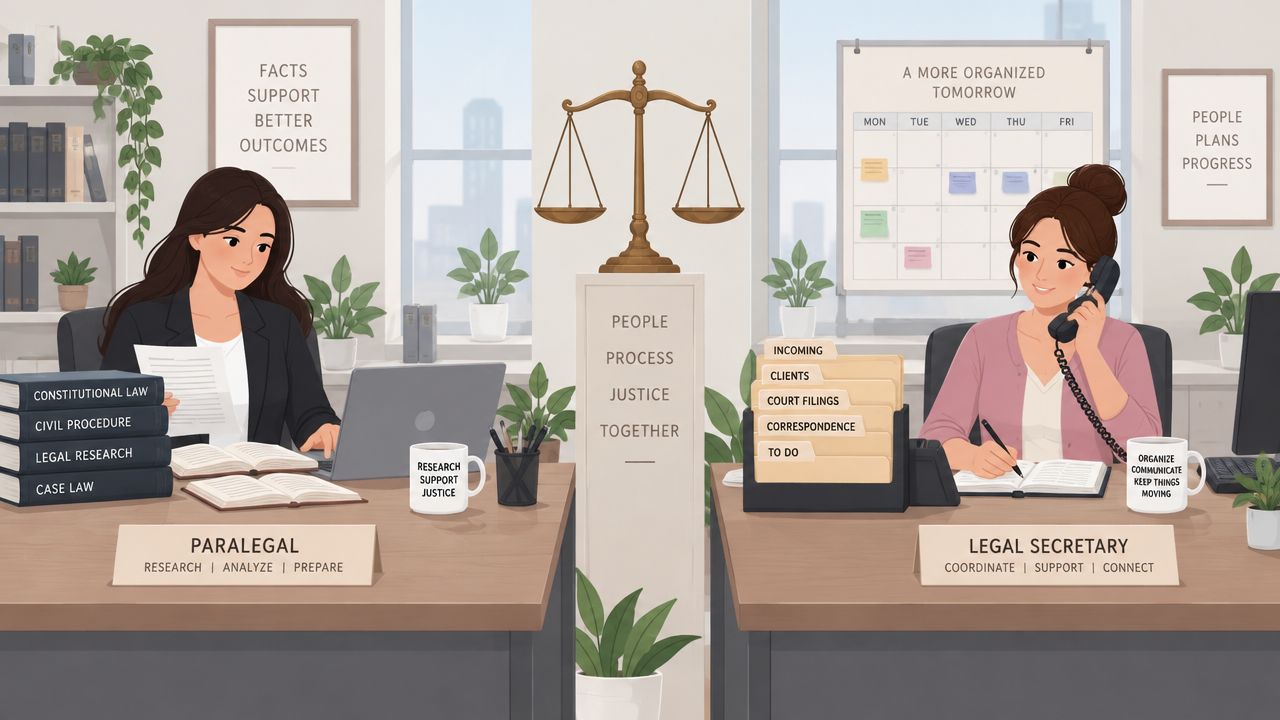
A firm feels the difference between these roles in day-to-day workflow, not just on an org chart. Paralegals are closer to the legal work itself. Legal secretaries are closer to the systems that keep that work moving. The split is practical, and it shows up in how attorneys delegate, review, and bill time.
Paralegals and legal assistants support lawyers with research, drafting, file organization, and case preparation. In litigation, that can mean pulling records, organizing discovery materials, drafting first-pass documents, preparing exhibits, and keeping the case file ready for attorney review. The BLS describes the role as substantive legal support, not simple clerical help. BLS career outlook article on careers in law firms
That distinction matters in the file. A good paralegal cuts attorney rework. The attorney should not have to rebuild the record, rewrite every draft, or chase missing research before a deadline. In a plaintiff practice, the better measure is research throughput, drafting volume, and case-prep output, not phone coverage or reception support.
Legal secretaries keep the operational edges tight. They handle correspondence, filing, scheduling, calendar management, document formatting, proofreading, and deadline tracking. Their work includes legal terminology and documents, but the job still centers on coordination and clerical support.
A strong legal secretary keeps the calendar clean, the reminders reliable, the intake notes usable, and the drafted document in the right format without repeated cleanup. That is not background work. It protects attorney time and keeps client communication from slipping into chaos.
Hire legal assistants who can flex across document support and coordination
| Task Allocation Matrix | Paralegal | Legal Secretary |
|---|---|---|
| Legal research | Primary responsibility | Occasional or limited |
| Drafting pleadings or substantive documents | Frequent responsibility | Formatting and preparation support |
| Discovery coordination | Often involved | May assist with tracking and document flow |
| Calendar and deadline management | May monitor matter deadlines | Core responsibility |
| Client calls and routine communication | Limited, matter-dependent | Core responsibility |
| Filing and document organization | Yes, as part of case work | Yes, as part of clerical support |
| Trial or hearing prep | Often involved | Supportive, administrative side |
| Proofreading and formatting | Sometimes | Core responsibility |
A firm gets into trouble when it asks a paralegal to cover phones all day or asks a secretary to carry substantive drafting without supervision. Both roles lose value when they are treated as substitutes for each other.
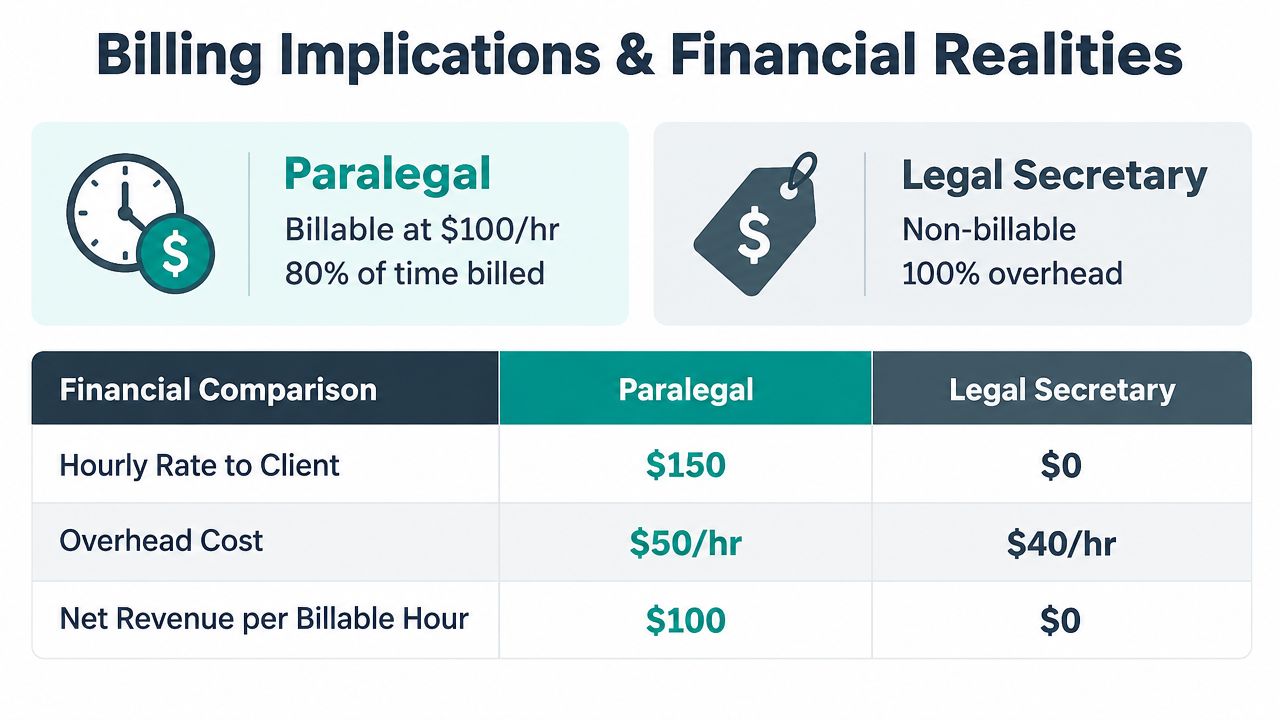
A staffing decision shows up in the ledger fast. If a paralegal is spending the day on intake calls, calendar cleanup, and file chasing, the firm is paying specialized wages for administrative output. If a legal secretary is pushed into substantive legal work that still needs attorney review, the firm takes on rework, slower turnaround, and more supervision than the budget may support.
The compensation side also affects how a firm sets billing expectations. The federal wage series for paralegals and legal assistants shows a role with a wide pay range, which usually means firms are competing on experience, efficiency, and independence, not just basic support skills. The current wage profile for the occupation is already a useful reminder that this seat is not cheap clerical labor. It is priced as skilled support, and firms should treat it that way.
The mistake is not hiring support. The mistake is assigning the wrong work to the wrong seat. A paralegal who spends hours on routine intake is underused, while a legal secretary who is asked to draft substantive material without close oversight can slow the matter down and create quality issues.
That misalignment also affects attorney behavior. When support work is inconsistent or overloaded, lawyers stop delegating or they redo work themselves, which cuts into realization. The firm may feel busy, but billable time is being spent on avoidable cleanup.
Legal secretaries are often treated as overhead because they support the office's operating rhythm rather than matter-specific production. That view misses the financial point. A good legal secretary reduces interruptions, keeps documents moving, and prevents avoidable coordination mistakes. A good paralegal advances substantive work so attorneys spend less time on repeat drafting and document handling.
Paralegal compensation has also moved enough to matter for planning. The historical wage series shows steady movement in both pay and employment, which is a sign that firms are competing for a recognized support specialty. BLS historical wage series for paralegals and legal assistants
That matters because payroll decisions affect utilization. If the work mix is mostly scheduling, intake, and formatting, a higher-cost paralegal seat can drag margins down. If the work mix includes drafting, discovery coordination, record review, and matter support that reduces attorney time, the same payroll line can be justified. The practical question is not what the title sounds like. It is whether the person's hours are being spent on work the firm can bill for directly, price into matter value, or absorb efficiently.
A comparison chart showing the financial differences between a paralegal and a legal secretary in billing. A comparison chart showing the financial differences between a paralegal and a legal secretary in billing.
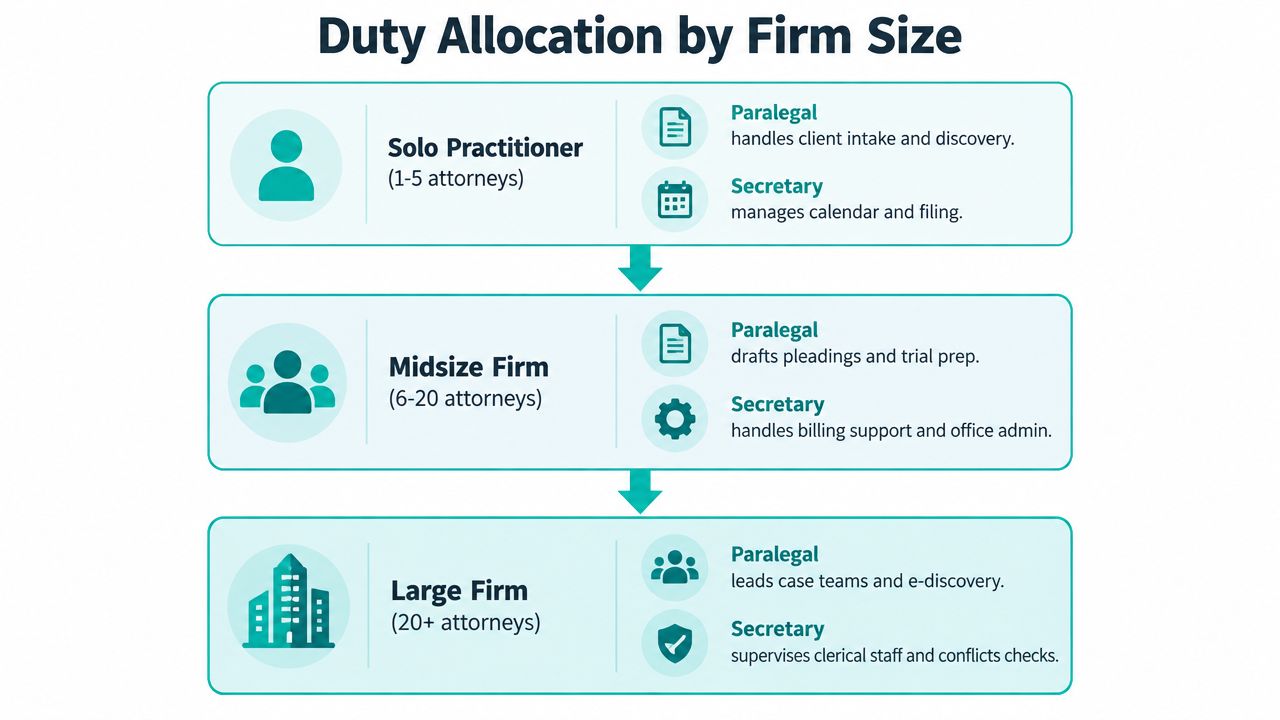
Small firms tend to blur support roles because they have to. Larger firms have the volume to separate them cleanly. The right answer depends less on theory and more on how many moving parts your team is trying to hold at once.
In a solo or small practice, the support person often has to cover intake, scheduling, document prep, and basic file management. That doesn't mean the role is undefined, it means the boundaries need to be explicit. If the person is handling client calls, intake notes, calendar entries, basic document formatting, and follow-up messages, that's a stronger fit for a legal secretary or legal assistant blend than for a narrowly defined paralegal seat.
A practical mistake here is hiring too narrowly. A small firm rarely benefits from a support person who only does one slice of the work if the attorney still needs coverage on every other front. A better approach is to map the weekly bottlenecks, then build a role around those bottlenecks. If intake is inconsistent and calendars are fragile, you need coordination first. If matter files are piling up and attorneys are rewriting every document, you need substantive support first.
As firms grow, the roles separate more clearly. Paralegals can stay closer to drafting, discovery, record review, and case prep. Legal secretaries can stay on formatting, deadlines, filing, and attorney coordination. That separation works because the volume justifies it, and because it reduces the chance that a high-skill employee gets trapped in administrative drag.
A larger team also benefits from tighter role design. A paralegal who can stay in the case file all day produces more consistent support than one who is constantly pulled into phones and receptionist coverage. A legal secretary who owns calendar discipline and document flow will usually outperform a mixed-role person who keeps getting interrupted by unrelated tasks. The more complex the firm, the more expensive role confusion becomes.
See how administrative support roles are structured for law firms
Use these questions before you hire or reshuffle duties:
The most useful staffing question isn't “What title do we want?” It's “What work keeps falling through the cracks, and who can own it without creating more cleanup?”
A lot of firms still try to solve support gaps with a local hire search that takes too long and costs too much relative to the actual workload. That's where remote bilingual support changes the equation. Instead of forcing the choice between an expensive paralegal and a basic office assistant, firms can use remote legal talent for the exact mix of intake, case updates, billing support, and client communication they need.
The operational value is straightforward. A bilingual remote assistant can cover English and Spanish communication, work in U.S.-aligned hours, and keep the firm responsive without forcing the attorney or local staff to absorb every touchpoint. That's especially useful in practices with high inbound volume, repeat status calls, or cases where the first response shapes client experience. Remote support doesn't replace licensed legal judgment. It helps the firm keep the administrative and client-facing engine running.
The strongest use case is not “outsource everything.” It's focused delegation. A remote legal assistant can handle intake follow-ups, scheduling, case-system updates, and billing administration while staying inside defined procedures. That lets attorneys and paralegals spend more time on the work that requires their training.
Remote hiring can also reduce friction in the recruiting process. For firms that need quick coverage, a pre-vetted shortlist and structured screening process can shorten the path from need to hire. In practices that already run on Clio, MyCase, Filevine, or similar platforms, software familiarity matters more than physical presence. If the person can log in, understand the workflow, and keep the file moving, the office location matters far less than many firms assume.
This model tends to work well for immigration, personal injury, family law, and civil litigation practices, especially when bilingual communication and consistent follow-up matter. It also works for firms that need a support person who can flex between intake, calendar management, client reminders, and basic file updates without requiring a full paralegal salary structure.
The biggest limitation is scope. Remote staff still need clear guardrails. They shouldn't provide legal advice, independently make legal decisions, or drift into tasks that require attorney judgment. But within a well-run workflow, they can remove a surprising amount of friction from the day.
Explore remote legal assistant support for law firms
The paralegal vs legal secretary decision is really a staffing design decision. If the bottleneck is research, drafting, discovery support, or matter-level legal production, a paralegal is the cleaner fit. If the bottleneck is calendars, formatting, calls, intake coordination, and document flow, a legal secretary is the better use of payroll.
Most firms don't need a perfect title match. They need the right task mix. Start by listing the work attorneys keep touching twice, then separate what needs substantive legal support from what only needs disciplined coordination. That one exercise usually makes the hiring choice much clearer.
If you're still sorting through a live staffing gap, the safest next move is to map your current tasks before you post another job. A firm that knows exactly what it needs can hire more accurately, train faster, and stop paying senior talent to do junior work.
If your firm needs bilingual remote support that fits real legal workflows, Virtual Legal Assistants can help you find pre-vetted talent for intake, scheduling, case updates, and administrative coordination. Visit Virtual Legal Assistants to review remote hiring options that align with your practice's workload and communication needs.