

 13 minutes read
A law firm owner often reaches the same hiring crossroads: the inbox is crowded, attorneys are losing time to scheduling and document follow-up, and a managing partner needs more control over priorities. The question is whether to hire an administrative assistant or an executive assistant. The titles overlap, but the jobs aren't interchangeable.
An administrative assistant supports an office, department, or group of attorneys through recurring operational work such as scheduling, records, invoicing, filing, and communications. An executive assistant supports one senior leader more directly, with greater ownership of calendar strategy, confidential correspondence, stakeholder access, follow-through, and high-priority projects.
The practical difference between admin assistant and executive assistant is scope, autonomy, and decision rights, not a longer task list or a more senior-sounding title. Choosing correctly affects billable time, client responsiveness, confidentiality, supervision, and the cost of a failed hire. This guide compares the roles, explains the compensation bands behind them, maps each position to common law-firm workflows, and provides a framework for hiring remote support, including bilingual professionals working U.S. hours.
An administrative assistant keeps a firm, practice group, or office function moving through repeatable workflows. The role may cover office communications, scheduling, record-keeping, invoicing, filing, document handling, and other clerical work for a department, as described in this overview of administrative assistant responsibilities.
In practice, that can mean maintaining intake records, routing calls, organizing matter folders, updating Clio or MyCase, coordinating consultations, preparing billing information, and following up on missing documents. One assistant may support several attorneys and staff members, applying defined procedures so routine work does not accumulate.
New-client intake shows the boundary clearly. An administrative assistant can monitor an intake inbox, collect contact information, send approved questionnaires, schedule consultations, and update the case-management system. Evaluating whether a potential client has a viable legal claim and providing legal advice remain with qualified firm personnel.
An executive assistant works more closely with a managing partner, practice-group leader, or firm owner. Scheduling and correspondence remain part of the job, but the assistant also protects the leader's priorities through independent judgment. The official occupational description for executive administrative support includes work such as preparing statistical reports, handling information requests, arranging conference calls, and scheduling meetings.
The role can include controlling access to the partner's calendar, preparing meeting materials, coordinating travel, monitoring deadlines, drafting correspondence for review, handling sensitive information, and following up with internal and external stakeholders. Calendar ownership is the clearest practical distinction. A gatekeeper assesses urgency, sequences competing requests, protects preparation time, identifies conflicts, and knows which issues require escalation.
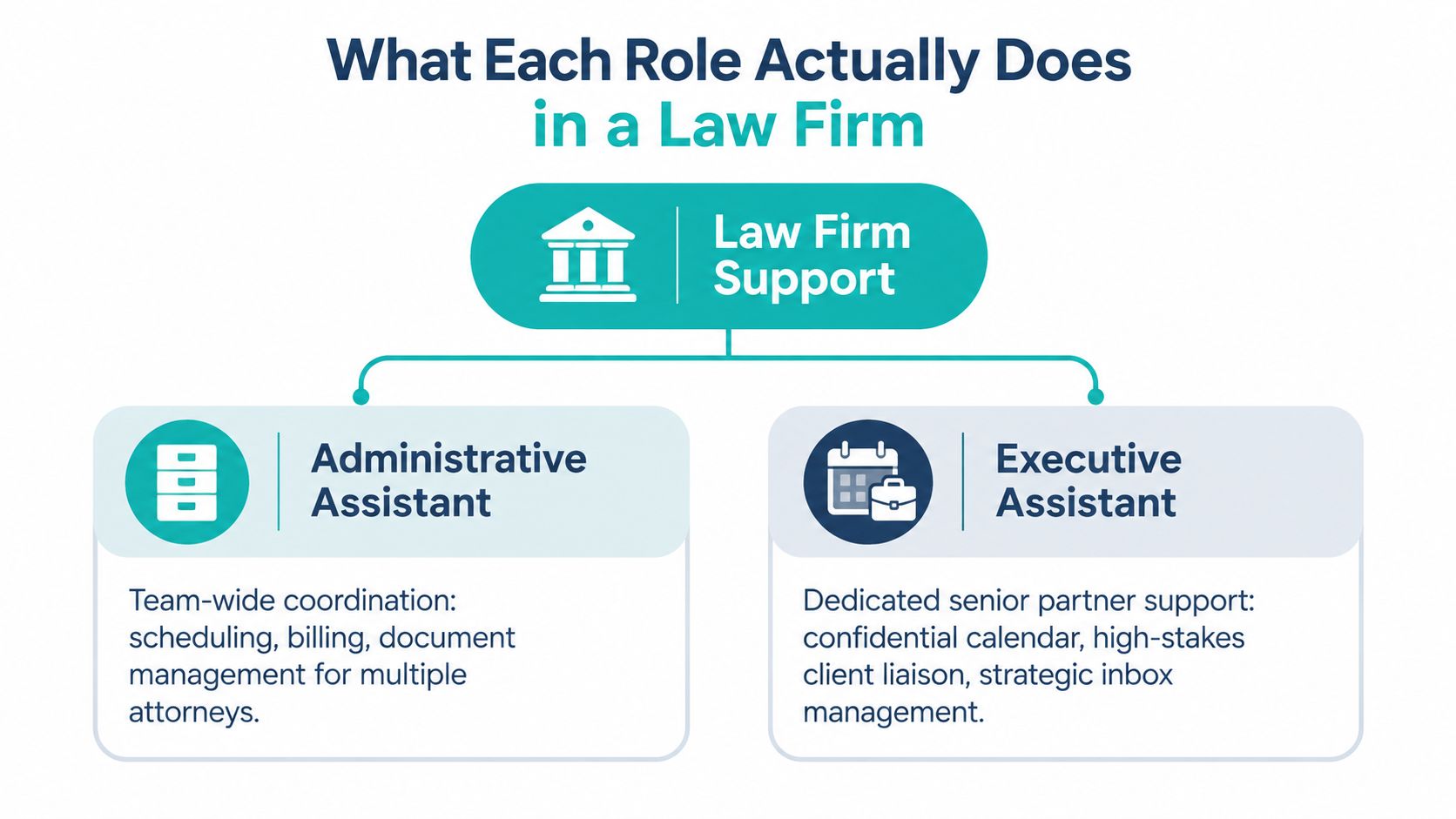
Titles overlap across firms, so the job description should define the actual operating model. An administrative assistant can become an EA in practice when the role shifts from completing assigned team workflows to owning a leader's priorities, access, confidentiality, and follow-through.
Before recruiting, specify who the assistant supports, which information they may access, what decisions they can make without approval, and which outcomes they own. Team-centered, process-driven work can also be staffed through remote administrative assistant support for law firms, provided access controls, escalation rules, and communication hours are documented. The right title follows those decision rights, not the other way around.
The cleanest comparison starts with decision rights. An administrative assistant generally executes established workflows across a team. An executive assistant manages a leader's operating environment and may decide how work is prioritized, routed, and followed through.
Industry guidance also distinguishes the roles by ownership and judgment, rather than by task labels alone. Both assistants might schedule meetings or handle email, but an EA owns the context around those tasks, as discussed in this remote executive assistant role comparison.
| Criteria | Administrative Assistant | Executive Assistant |
|---|---|---|
| Primary support | An office, department, practice group, or several attorneys | One managing partner, senior attorney, or firm leader |
| Autonomy | Works within documented processes and escalates exceptions | Makes routine prioritization decisions within agreed authority |
| Confidentiality | Handles matter, billing, client, and office information according to access rules | Often serves as a trusted filter for sensitive strategy, relationships, and leadership communications |
| Calendar responsibility | Books appointments and coordinates shared schedules | Owns calendar architecture, priority conflicts, preparation time, and access |
| Stakeholder exposure | Communicates with clients, vendors, staff, and prospective clients | Represents or coordinates for a senior leader with clients, partners, opposing-side contacts, and internal leadership |
| Project coordination | Tracks assigned tasks and updates systems | Drives follow-through, monitors dependencies, and escalates blockers |
| Supervision model | Usually receives task-level direction from an office manager or team lead | Works through a close operating relationship with the supported executive |
An administrative assistant's queue belongs to the team. A legal receptionist, intake coordinator, or billing support assistant may have several internal customers and must balance requests through established priorities.
An executive assistant's queue belongs primarily to the leader. That doesn't mean the EA refuses every request from other people. It means the EA evaluates those requests against the executive's commitments and goals before placing them on the calendar or in the inbox.
An administrative assistant may flag that two meetings conflict. An executive assistant is more likely to know which meeting can move, who should be contacted first, what preparation time is required, and whether the conflict exposes a larger scheduling problem.

Practical rule: If the person must decide what deserves the partner's attention before the partner sees it, you're defining an EA role.
For an administrative assistant, useful measures may include accurate matter updates, reliable intake handoffs, timely billing support, organized records, and consistent completion of recurring tasks. For an executive assistant, the measures should include dependable priority management, clean meeting preparation, timely follow-through, appropriate escalation, and confidentiality.
The distinction also changes screening. Administrative candidates need process discipline and attention to detail. EA candidates need those abilities plus discretion, communication judgment, composure, and the confidence to challenge an unrealistic calendar or ask a senior attorney for clarification.
Compensation makes the difference between admin assistant and executive assistant visible, but the pay gap reflects more than tenure. It usually follows the role's scope, decision rights, confidentiality requirements, and proximity to senior leadership.
The U.S. Bureau of Labor Statistics reported a May 2025 median annual wage of $76,590 for executive secretaries and executive administrative assistants. The top 10% earned $109,850 or more, while the middle 50% ranged from $61,390 to $94,390, according to the BLS occupational wage data.
The broader secretaries and administrative assistants group had a May 2025 median of $48,310. That puts the executive-assistant category $28,280 higher at the median, or roughly 58% above the broader administrative-support benchmark, using the same BLS figures.
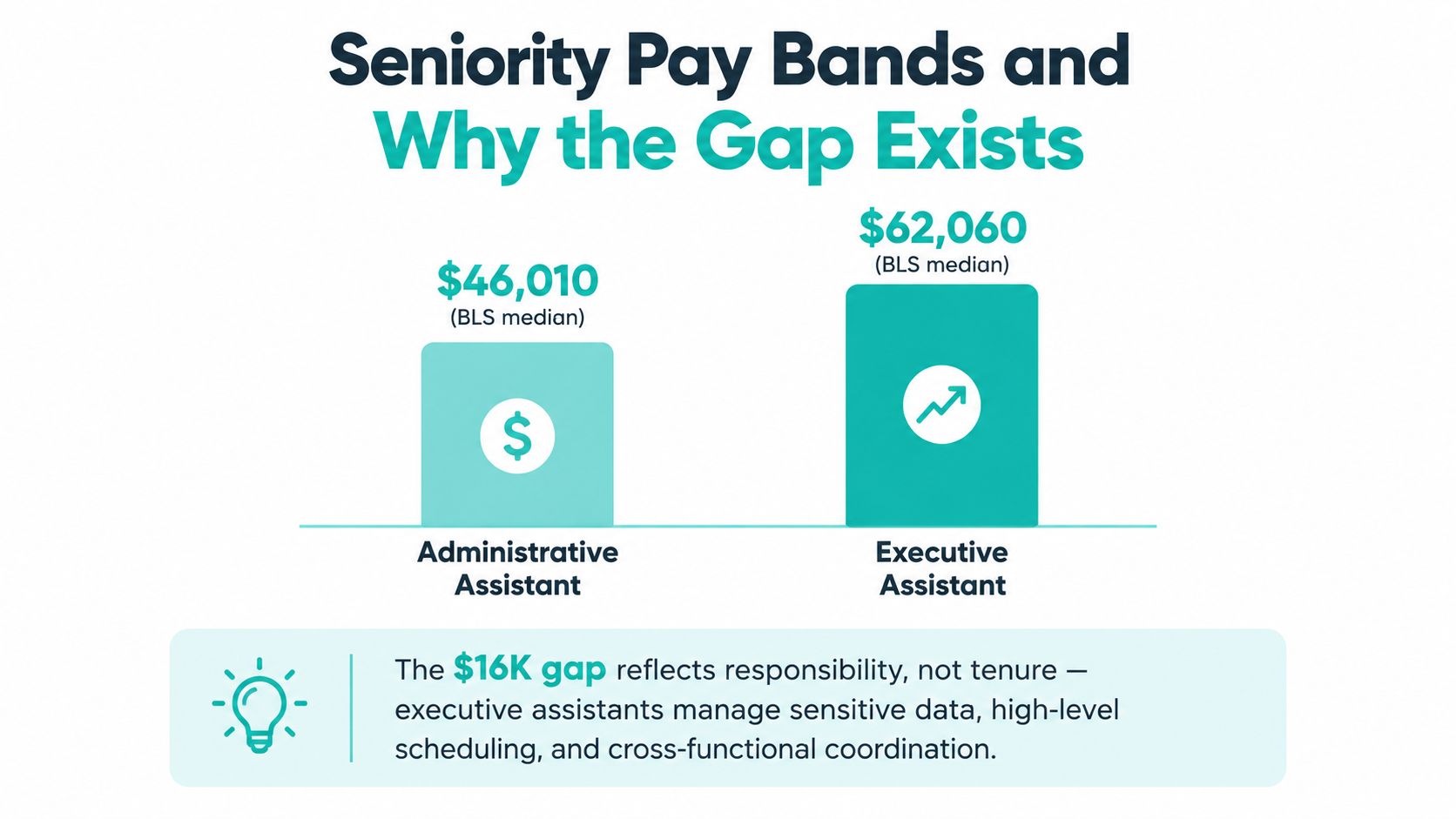
These figures are reference points, not automatic salary offers. Location, employment structure, experience, specialty, schedule, and practice complexity all affect compensation. The useful takeaway is that the market generally prices administrative support and executive support as different scopes of work.
The historical pattern points in the same direction. The executive administrative assistant occupation had a BLS median of $70,310 in 2023, $65,980 in 2022, and $60,890 in 2019, as reflected in the executive administrative assistant records. Those figures indicate a separately tracked role with a higher compensation ceiling than broad administrative support.
For a practice manager, title and authority must match. An EA title attached to routine filing and shared scheduling can lead to overpaying for limited scope and disappointing the hire. An administrative assistant posting that expects independent partner gatekeeping, confidential strategy support, and project ownership will understate the job and attract mismatched candidates.
Set the pay band after defining decision rights. An administrative assistant handling intake, billing administration, records, and office coordination should be assessed for consistency and workflow accuracy. An executive assistant supporting a managing partner should be assessed more heavily for discretion, prioritization, communication, calendar ownership, and judgment.
Remote staffing adds another cost question. Use law-firm virtual assistant pricing information when comparing models, then account for supervision, coverage, onboarding, software proficiency, and unclear authority. A lower hourly rate is not economical if the partner still reviews every calendar decision or chases every follow-up.
The right choice depends on where the bottleneck sits. If the entire office is struggling with records, intake, scheduling, or billing coordination, the firm needs administrative capacity. If one senior attorney can't control a calendar, inbox, or flow of commitments, the firm needs executive capacity.
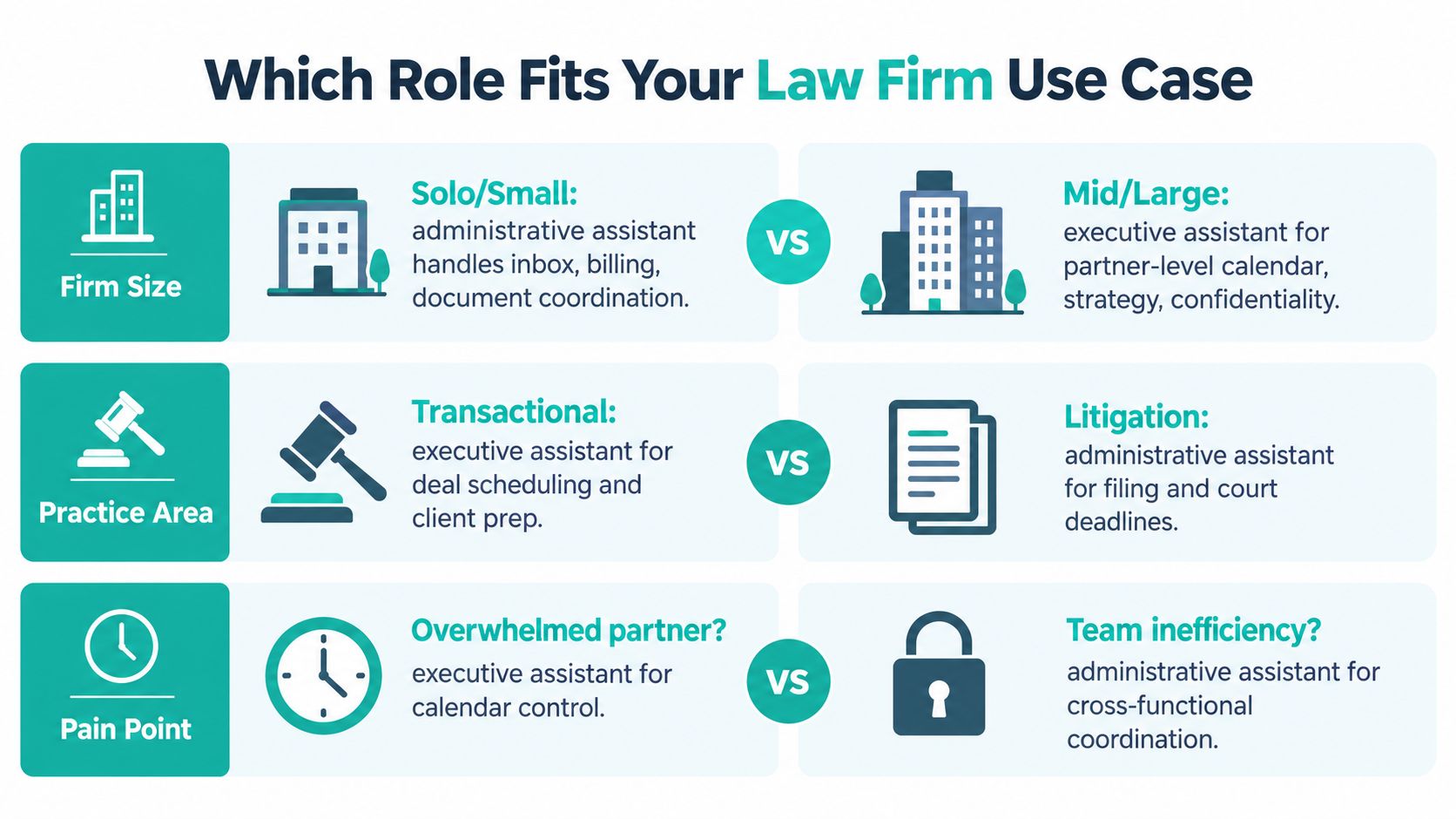
A solo attorney or small practice often needs broad support before it needs dedicated executive support. One remote administrative assistant may coordinate consultation requests, update matter records, organize documents, send billing reminders, route calls, and keep the attorney's routine appointments organized.
That arrangement works when the attorney still makes the substantive decisions and the workflows are reasonably repeatable. It becomes strained when the assistant is expected to distinguish urgent legal strategy from routine correspondence, manage complex partner-level relationships, or rearrange the attorney's commitments without clear guidance.
Practical takeaway: Start with an administrative role when the pain is scattered office work. Upgrade the scope when the assistant begins owning the attorney's priorities rather than only processing requests.
A midsize firm may need both roles. An administrative assistant can support a practice group with intake, case-system updates, document coordination, billing administration, and shared scheduling. An EA can support the managing partner or group leader with leadership meetings, partner communications, calendar protection, and special projects.
The handoff must be explicit. For example, the administrative assistant may collect availability and prepare a scheduling request, while the EA decides whether a partner should attend, which commitments take precedence, and how the meeting fits the leader's priorities.
Practical takeaway: Use shared administrative coverage for repeatable team workflows and reserve EA capacity for decisions that require leadership context.
Transactional practices may place more weight on meeting preparation, client coordination, deal timelines, and confidential partner communications. Litigation practices may need stronger administrative support for filing coordination, document organization, deadline tracking, and case-system maintenance.
Immigration, personal injury, and family-law practices may also benefit from bilingual English and Spanish support when client communication and follow-up require language alignment. Bilingual ability doesn't authorize an assistant to interpret legal rights, make legal judgments, or perform licensed work. The firm should provide approved scripts, escalation rules, and supervision.
Practical takeaway: Match the role to the workflow and the communication boundary, not just the practice-area label.
Hiring an EA for routine team clerical work can waste the premium associated with leadership support and leave the firm short on processing capacity. Hiring an administrative assistant for a partner who expects independent gatekeeping can create missed priorities, excessive supervision, and inappropriate access to sensitive conversations.
Write the first version of the role around the problem you need solved. Ask whether the hire will own team throughput or leader effectiveness, then assign access and authority accordingly.
A reliable hiring decision begins with four questions:
Write a responsibility matrix with three columns: the assistant owns, the assistant supports, and the assistant escalates. Include the firm's systems, such as Clio, Filevine, MyCase, CASEpeer, Smokeball, or RingCentral, but confirm actual proficiency during screening rather than assuming that software names on a résumé prove competence.
For remote staff, document working hours, response expectations, communication channels, meeting norms, and backup coverage. A bilingual assistant may be valuable for client-facing workflows, but the firm should identify which communications require attorney review and which approved templates the assistant can use independently.
Start with access limited to the systems and matters required for the role. Establish a short recurring review with the supervising attorney or manager, then expand decision rights as the assistant demonstrates reliable judgment. HIPAA isn't the governing framework for ordinary law-firm operations, but confidentiality, client agreements, state privacy rules, and professional obligations still require careful access control. Confirm the firm's specific obligations with qualified counsel or a compliance professional.
The legal virtual assistant staffing option can be considered when a firm wants remote legal support aligned with its systems and workflows. Regardless of provider, the firm remains responsible for defining supervision, access, confidentiality, and escalation.
Review the role after the initial onboarding period and again when the workload changes materially. If an administrative assistant has become the person who controls a partner's calendar, filters stakeholders, manages sensitive correspondence, and drives projects, the firm should revisit the title, pay band, authority, and training.
The opposite problem also occurs. An EA hired for partner support may spend most of the week processing shared billing or routine records. Move that work to administrative coverage where possible, or rewrite the role so the firm isn't paying for judgment it isn't using.
The core difference between admin assistant and executive assistant is the operating scope. An administrative assistant provides broad, team-level support across scheduling, records, documents, billing, intake, and office coordination. An executive assistant provides higher-trust support to a senior attorney or managing partner, with greater ownership of calendars, priorities, confidential communication, stakeholder access, and follow-through.
Choose an administrative assistant when the bottleneck is the firm's shared workflow. Choose an executive assistant when the bottleneck is a leader's attention, calendar, or decision flow. Before posting either role, define the supported person or team, access requirements, decision rights, escalation rules, software expectations, and success measures.
For firms evaluating remote bilingual support, Virtual Legal Assistants offers pre-vetted professionals for legal administrative and executive-support workflows, with matching based on firm requirements and the opportunity to interview candidates before hiring. Visit Virtual Legal Assistants to review support options and define the role that fits your firm's actual workload.