

 13 minutes read
You may think you need another admin hire when the calendar is slipping, voicemail is backing up, and the front desk is covering too many loose ends. In practice, hiring a personal assistant is usually a workflow decision first and a staffing decision second. The right person can protect provider time, keep patient communication moving, and reduce the drag that comes from constant interruption. The wrong one can create more handoffs, more follow-up, and more risk around privacy and discretion.
That's why the core question isn't just who looks organized on paper. It's what the assistant will own, what they must never touch, and how much judgment the role requires when plans change. In medical practices, that distinction matters even more because patient-facing communication, scheduling, billing support, and sensitive information can overlap in ways that look simple until something goes wrong. This guide focuses on those gray areas, the ones that most hiring checklists skip.
A practice owner often starts with a vague need, maybe help with calls, scheduling, inbox cleanup, and a few personal tasks that keep bleeding into work hours. The first candidate can look fine on paper, answer well in a short interview, and still fail once real workflows start. The issue usually isn't competence in the abstract. It's that the role was never defined tightly enough for the candidate to succeed.
That ambiguity shows up fast in healthcare. A personal assistant who can book appointments may still freeze when a patient sends a message that mixes billing questions, medical concerns, and a complaint about turnaround time. A person who is “good with people” may still overshare, move too quickly, or take action outside the boundary you meant to set. In a practice, those mistakes don't just waste time. They can affect trust.
The broader hiring market shows why screening matters more than volume. One staffing benchmark says an average search attracts about 112 applications, yet the firm reporting it rejects close to four candidates for every one it accepts, which is a strong reminder that a pile of resumes doesn't solve fit by itself. The U.S. Bureau of Labor Statistics also reports that secretaries and administrative assistants held about 3.5 million jobs in 2025 and still have about 314,400 openings projected each year on average over the 2025 to 2035 decade, which tells you these roles remain foundational business infrastructure. Virtual assistant services market data, U.S. administrative assistant employment outlook


Practical rule: if you can't explain the assistant's boundaries in one paragraph, you're not ready to hire yet.
A smarter approach is to treat hiring as a design problem. Define the work, define the limits, then recruit against the shape of that role. That's the difference between buying relief and buying chaos.
The fastest way to waste time is to post for a “personal assistant” when you need a mix of receptionist, scheduler, patient coordinator, and back-office support. In medical practices, that title is too broad to be useful unless you decide what lives inside the job and what stays out. If the role includes patient messages, insurance follow-up, or billing support, the candidate needs a different skill profile than someone who just manages a calendar and orders supplies.
The source of most hiring friction is scope. One assistant may be strong at recurring admin work, while another can handle sensitive communication and judgment calls. If you blur those together, you'll either overhire for routine work or underhire for the complexity you need. That's why a clear role definition should include duties, software familiarity, escalation rules, and communication expectations before you ever write the posting.
| Role Tier Comparison | General Admin | Specialized Support |
|---|---|---|
| Core work | Calendar upkeep, reminders, inbox sorting, document prep | Patient coordination, insurance follow-up, billing support, prior authorization, message triage |
| Judgment level | Low to moderate, with scripted tasks | Moderate to high, with escalation and discretion |
| Software need | Basic office tools and scheduling platforms | Practice systems, call tools, billing or intake workflows |
| Best fit | Simple, repeatable admin loads | Practices with sensitive communication or complex handoffs |
A useful way to think about it is by boundary, not by title. If the assistant will ever hear private patient details, handle off-hours requests, or decide what gets escalated, the role needs more than organization. It needs judgment and discretion. That's the part many job posts miss.
Boundary test: write down three things the assistant must never do, then build the job around those limits.
A lot of practice managers also benefit from a process-first mindset. One internal hiring resource on how to hire administrative assistants reinforces the same practical point, a role works better when the tasks are concrete and the expectations are visible. If you're hiring for broader support, a service like Virtual Legal Assistants may also be relevant because it matches operational roles to firm workflows rather than leaving the scope vague.
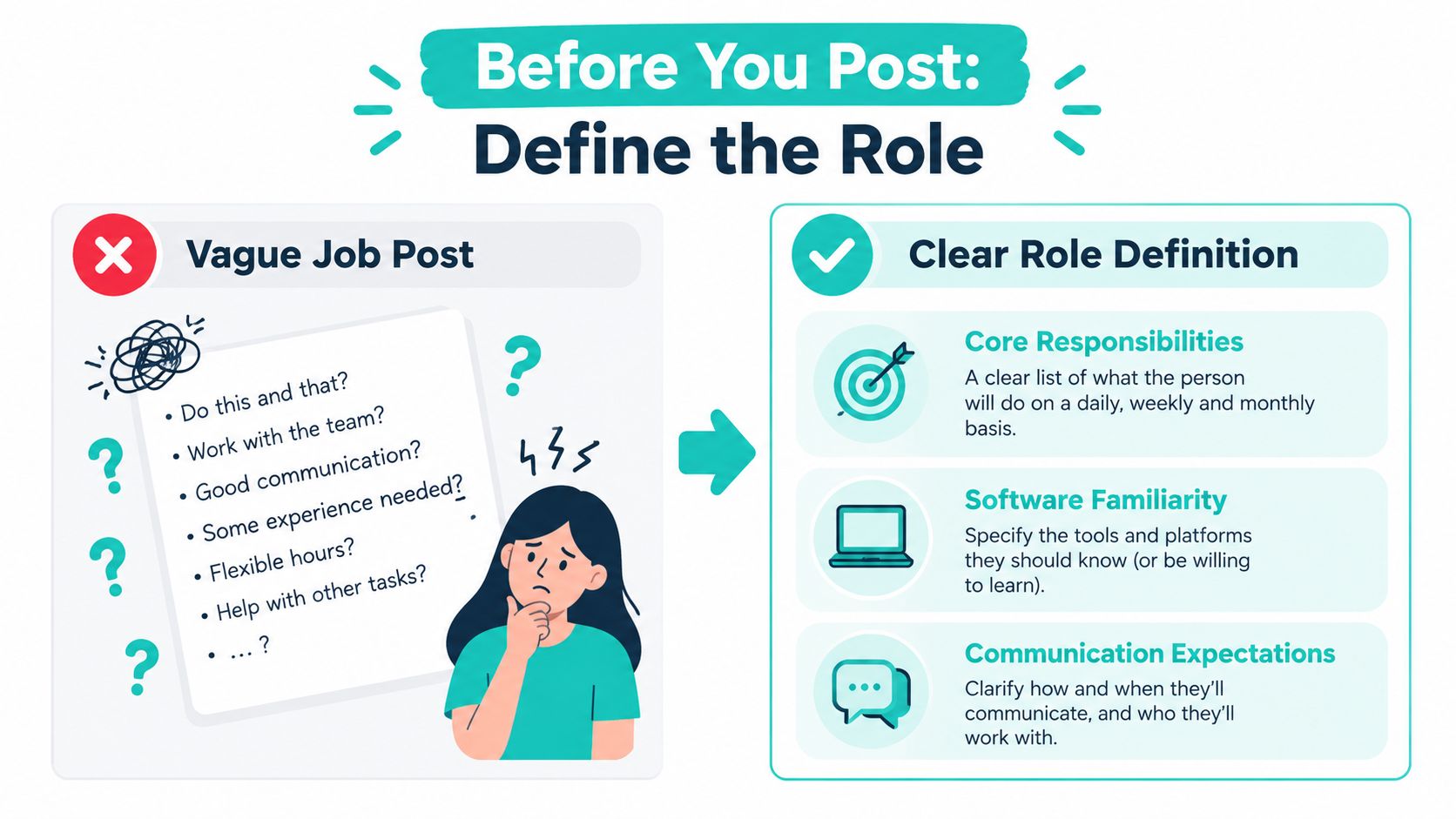
If you do this well, interviewing gets easier immediately. You're no longer asking “Are you organized?” You're asking whether the person can handle the exact workflow your practice needs.
Generic job boards can produce a lot of applicants, but in my experience that volume often hides more problems than it solves. You get people who say they've done “admin work” without ever touching a healthcare workflow, and you spend too much time filtering out candidates who can't work your hours or adapt to your systems. That's expensive, even when the hourly rate looks cheap at first.
For medical practices, sourcing should start with fit. If you need bilingual patient support, U.S. schedule overlap, or someone comfortable with structured remote collaboration, a general marketplace may not be the shortest route. Pre-vetted providers can reduce screening time because they've already filtered for availability, communication style, and role alignment. That doesn't make them automatically right, but it does mean you start from a more useful candidate pool.
There's also a trade-off between direct recruiting and a managed or curated model. Direct recruiting gives you more control, but it puts the burden of screening, scheduling, and rejection on your team. Curated sourcing costs more in the middle, yet it can save real time if your practice is already stretched. That matters because low-cost hires create friction when they need constant clarification, miss nuances in patient communication, or don't know how to work inside a defined workflow.
A structured sourcing path also helps you avoid overfitting to personality. Someone can be friendly and still be wrong for a practice if they can't follow boundaries, document accurately, or handle repeat requests without losing consistency. That's why I'd rather see a smaller shortlist with evidence than a giant pile of uncertain options.
Practical rule: pay for less noise, not more resumes.
If you're hiring for a role that blends support and judgment, broader legal and administrative staffing resources can still be useful. A page focused on legal virtual assistants is a reminder that specialized support is often sourced differently from generic admin labor, especially when the work depends on discretion and process discipline.
A polished interview can hide a lot. The candidate who speaks confidently about organization may still struggle the moment a patient sends a sensitive message, a provider changes a schedule at the last minute, or two staff members give conflicting instructions. That's why resumes and short interviews are weak predictors for this role. They tell you who can talk about support work, not who can actually carry it.
The strongest guidance I've seen is simple: meet assistant candidates at least three times before deciding, and pay close attention to candidates who've had external leadership experience. That lines up with the reality of hiring assistants in practice settings, where the work is less about generic admin talent and more about consistency under pressure. Hiring guidance for assistants

Asking, “Are you trustworthy?” rarely tells you anything useful. Everyone answers yes. Scenario questions do the work because they force the candidate to show how they think.
Use prompts like these:
The goal isn't to find perfect answers. It's to see whether the candidate recognizes boundaries, stays calm, and asks for clarification at the right time. That's especially important in healthcare, where the worst mistakes usually come from overconfidence, not bad intent.
Observation beats theory: a candidate who asks clarifying questions usually understands risk better than one who tries to sound certain.
Score each candidate on a simple three-part lens.
Execution
Communication
Problem-solving
One hiring guide also points out that many candidates look strong until you press beyond the resume, which is why multiple touchpoints matter. In a medical practice, that pressure test is not optional. You need to know how someone behaves when instructions aren't neat.
Hiring is the easy part compared with getting the person productive without creating dependency or confusion. A remote assistant needs structure early, especially in a practice where call flow, scheduling rules, and patient communication standards affect daily operations. If you don't set the rhythm, the assistant will build habits around whatever is easiest, not whatever is best.
A solid first 90 days starts with process documentation. Don't hide everything in conversations or memory. Write down the most common tasks, the handoff points, and the exceptions that should always be escalated. That's the difference between a person who can support you and a person who constantly interrupts you for clarification.
First 30 days
Days 31 to 60
Days 61 to 90
The key is to monitor performance without turning into a micromanager. I've seen practice owners hover too closely, then back off too quickly, and both patterns cause trouble. You want early feedback, not endless correction. You also want a simple way to see whether the assistant is keeping up without checking every single task.
Management rule: correct small problems early, before they become the assistant's default behavior.
If your practice handles patient-facing communication or billing workflows remotely, that boundary work matters even more. Healthcare remote staffing often covers scheduling, intake, prior authorization, insurance verification, billing, accounts-receivable follow-up, credentialing, and documentation support, so the role should stay firmly inside the tasks your practice allows. HIPAA applies to telehealth appointments, messages, and related health and billing information, and HHS says covered providers must use telehealth platforms that support secure communications and data storage. That makes workflow discipline a compliance issue, not just a management preference. HHS telehealth privacy and security guidance, remote healthcare administrative support functions
A remote assistant can work very well when the practice gives them a clean operating system. They struggle when the owner expects them to read minds or absorb every loose task in the office. Good onboarding prevents both problems.
Hiring a personal assistant is not just about offloading work. In a medical practice, it's about deciding where support ends, where discretion begins, and which tasks should stay human because they affect patient trust or operational judgment. The practices that get this right treat the role as a workflow design decision, not a generic admin hire.
Start with clear boundaries, then screen for judgment with scenario-based interviews, not broad personality questions. After that, onboard with a written process, measured escalation, and steady correction in the first 90 days. That combination is what turns an assistant into real operational relief instead of another person who needs constant management.
If your practice needs remote support with defined boundaries, Virtual Legal Assistants connects teams with pre-vetted bilingual operational staff and workflow-aligned hiring support. If you're ready to replace guesswork with a structured hiring process, visit the site and review the roles that fit your schedule, systems, and patient communication needs.