
 16 minutes read
Only 25% of law firms respond to online leads in under five minutes, while 26% never respond at all. A legal intake specialist is the revenue-critical gatekeeper who answers inbound inquiries, qualifies potential matters against firm criteria, records case facts, and books consultations before an opportunity disappears.
That role sits between marketing and legal service delivery. The specialist doesn't provide legal advice or replace an attorney. Instead, they create a reliable path from a phone call, web form, chat, or email to a properly documented consultation. For a personal injury firm, that may mean capturing the incident timeline and insurance information. For an immigration practice, it may mean identifying the client's situation, language preference, and basic eligibility factors before routing the inquiry.
The distinction matters because many firms assign intake to whoever happens to be available. Receptionists, legal assistants, attorneys, and case managers may all touch a new inquiry, but they don't perform the same job. When ownership is unclear, calls go unanswered, qualification becomes inconsistent, and attorneys spend valuable time collecting information that should have been gathered earlier.
This guide explains what a legal intake specialist does, how the role differs from a receptionist or case manager, how to build a fast intake workflow, which skills and software matter, and when remote bilingual staffing can improve coverage without adding another operational burden.
A law firm can lose a prospective matter before an attorney reviews it. An unanswered call, incomplete web form, or late callback can end the opportunity at the first contact. The legal intake specialist role exists to control that vulnerable point in client acquisition.
One widely cited industry summary reports that 35% of calls to law firms go unanswered during business hours, while 78% of legal clients hire the first law firm that responds. The same source estimates that a dedicated specialist costs about $40,000 to $60,000 per year in salary alone. The operational question is therefore whether the firm can provide reliable coverage and convert inquiries without assigning every first conversation to an attorney.
A specialist connects five tasks that are often scattered across a firm:

Operational rule: Attorneys should define acceptance criteria. Intake staff should collect and organize the initial information against those criteria.
The modern intake specialist developed as firms adopted client-relationship systems, online lead sources, and faster response expectations. By the 2020s, many practices treated intake as a defined workflow rather than an informal receptionist duty. A salary estimate of $40,000 to $60,000 shows why firms assess the role as a staffing and conversion decision, not as front-desk coverage. A legal intake specialist career summary provides additional context on the position.
The measurement standard also changes. Receptionists may be assessed on call handling, message accuracy, and office support. Intake specialists need measures for response time, record completeness, qualification accuracy, consultation attendance, and follow-up discipline. These measures do not place responsibility for every signed matter on one employee. They reveal whether the firm has built a dependable route from new inquiry to attorney review.
Remote bilingual staff can strengthen that route when language coverage or after-hours availability is limited. The benefit depends on execution. A remote specialist needs approved scripts, secure systems, clear escalation rules, and regular feedback. A local employee may offer closer supervision and institutional knowledge, while a remote arrangement can expand coverage and language access. Neither option compensates for unclear ownership or inconsistent qualification rules.
The easiest way to distinguish these roles is to ask where the employee's responsibility begins and ends. A receptionist protects the front door of the office. An intake specialist manages the path from potential client to qualified consultation. A case manager works further downstream, after the firm has accepted and opened the matter.
A law firm receptionist may answer the main line, greet visitors, route calls, take messages, support calendars, and manage routine office communication. They can capture basic contact information, but they generally aren't responsible for applying detailed case-acceptance criteria or running a structured follow-up cadence. Firms that need this broader front-office coverage may use a dedicated legal receptionist rather than assigning intake responsibilities to the same person by default.
The intake specialist has a narrower but more conversion-focused remit. The role's first contact includes fact gathering, qualification, conflict-related information collection, consultation scheduling, and repeated follow-up through signed representation or disqualification. A job description for the role also emphasizes complete case-management entries and confidentiality, not just polite call answering.
The case manager owns active matters after engagement. Depending on the practice, that can include milestone tracking, client updates, document coordination, deadline monitoring, and communication with attorneys, providers, insurers, or other participants. A case manager may receive a qualified lead from intake, but shouldn't be treated as a substitute for a dedicated lead-response function when new inquiries arrive in volume.
| Role | Primary Focus | Key Performance Metric |
|---|---|---|
| Receptionist | General call answering, routing, messages, visitors, and calendar support | Accurate routing and reliable availability |
| Legal intake specialist | Lead response, case qualification, data capture, follow-up, and consultation booking | Qualified inquiries moved to the correct next step |
| Case manager | Active-matter progression, client communication, and milestone tracking | Complete, timely movement of opened matters |
A small firm may reasonably combine duties. One employee can answer calls and conduct intake if the manager has trained them for both functions and protects enough time for qualification. The problem starts when the job title says “receptionist,” but the firm expects conflict screening, detailed case assessment, documentation, and persistent follow-up without changing the training or performance standards.
The reverse problem is just as costly. An intake specialist may be pulled into filing, billing, document preparation, or active-client communication until new leads wait in the queue. The firm then concludes that intake “isn't working,” when the actual issue is role dilution.
Hiring test: If the main performance question is “Did we answer and route the call?”, you're measuring reception. If it's “Did the right prospect receive a timely, complete path to consultation?”, you're measuring intake.
Speed-to-lead is the clearest operational variable firms can control. Hennessey Digital's 2025 study found that 25% of law firms replied to online leads in under five minutes. The median first-response time was 13 minutes, down from 21 minutes in 2023.
Internal benchmarks indicate that firms responding within five minutes qualify substantially more leads than firms waiting 30 minutes or longer, although results vary by lead source, practice area, geography, urgency, and qualification rules. Treat speed as a performance target, not a promise of signed representation. A fast response still needs accurate screening and a clear next step.
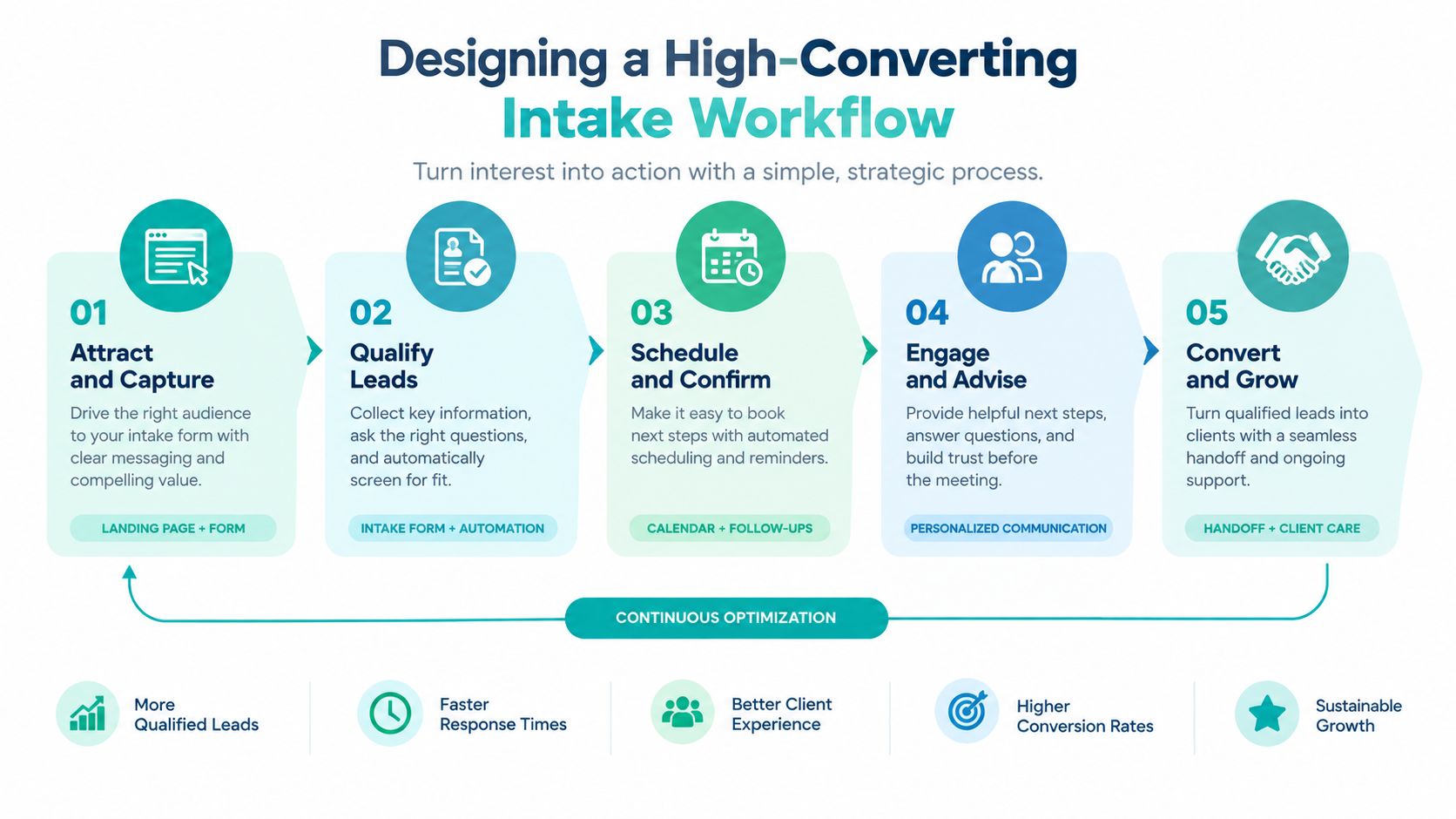
Assign one accountable owner to each stage. The person monitoring the queue should know which channel is active, what qualifies as urgent, and when attorney review is required. Attorneys should not serve as the default queue monitor unless the firm has deliberately planned for interruptions and reliable coverage.
A practical sequence includes:
Scripts should support judgment without making the conversation sound mechanical. A personal injury workflow may focus on incident date, injuries, insurance, and responsible parties. An immigration workflow may require a different question tree. Specialists need clear rules for attorney escalation and written criteria for disqualification.
Each inquiry should produce a traceable CRM or case-management record. Capture the source, time received, first response, factual summary, qualification status, assigned attorney or department, consultation time, and follow-up history.
A structured legal intake service can help maintain this process, but outsourcing does not transfer responsibility for acceptance criteria or quality control. Managers should sample records, compare them with consultation outcomes, and revise scripts when attorneys repeatedly receive incomplete or irrelevant information.
The workflow also requires firm boundaries. Intake staff may collect facts and explain procedures, but they should not give legal advice, promise results, independently interpret complex law, or make decisions reserved for licensed professionals. A written escalation list protects the prospect, the firm, and the attorney's time. Remote bilingual specialists can strengthen this workflow when they respond promptly and document meaning, urgency, and requested next steps accurately across languages.
A strong legal intake specialist combines customer communication with operational precision. Warmth matters because callers may be injured, frightened, angry, or uncertain about what happens next. Accuracy matters because a small error in a date, jurisdiction, opposing-party name, or contact detail can affect routing and attorney preparation.
Look for candidates who can demonstrate these capabilities rather than listing them on a résumé:
Bilingual skill isn't just a translation benefit. A specialist must preserve meaning, tone, dates, relationships, and urgency across languages. You should test both spoken and written communication, especially if the role includes Spanish-language forms, text follow-up, or client instructions.
A candidate who can speak well but can't maintain the firm's records will create a second bottleneck. Depending on the practice, the specialist may need to work in Clio, MyCase, Filevine, CASEpeer, SmartAdvocate, Smokeball, DocketWise, RingCentral, or connected intake and communication tools.
The exact platform matters less than the behaviors:
A practical assessment should give the candidate a fictional inquiry, a qualification checklist, and a sample record. Ask them to document the call, identify missing facts, route the matter, and write a follow-up message. This reveals more than a generic typing or customer-service test.
Manager's standard: Hire for judgment and documentation habits, then train firm-specific legal criteria. Don't assume software familiarity means the candidate understands your workflow.
Remote staffing is useful when it solves a defined coverage or capability problem. For intake, the most common problems are delayed first contact, limited evening coverage, language gaps, and the difficulty of finding someone who already understands a law firm's pace and confidentiality expectations.
LATAM-based professionals can offer schedule overlap across U.S. time zones, which supports live collaboration during the firm's working hours. Bilingual English-Spanish specialists may also let a firm serve callers in their preferred language without routing every conversation through an ad hoc interpreter or an attorney who should be handling legal work.
The financial comparison needs discipline. A U.S. employee's salary is only one part of the cost. The firm may also account for recruiting, payroll administration, benefits, workspace, software seats, training time, and coverage gaps. A remote arrangement can reduce some overhead, but the firm still needs to evaluate contractor classification, confidentiality, data access, supervision, and applicable state or federal obligations with qualified professionals.
Remote intake is often a strong fit when:
It isn't automatically appropriate for every practice. A highly specialized firm with rare matters may need deep substantive training before anyone outside the immediate team screens inquiries. A firm with poor documentation will export its chaos to a remote worker. Remote staff also can't compensate for an unavailable attorney, an unclear consultation process, or a case-management system nobody keeps current.
Virtual Legal Assistants connects U.S. law firms with pre-vetted LATAM professionals for roles including intake, reception, scheduling, case support, and administrative coordination. Its stated model includes bilingual English-Spanish talent, prior U.S. law-firm experience, interview-before-hire, no deposit, and a customized shortlist typically provided within 24 hours. Confirm current terms and suitability before making a staffing decision.
Remote talent gives you geographic flexibility, but it requires stronger management than an informal in-office arrangement. You need written scripts, access controls, communication channels, quality reviews, and a named attorney or manager for escalation. When those elements exist, remote staffing can function as a permanent part of the intake model rather than a temporary response to a vacancy.
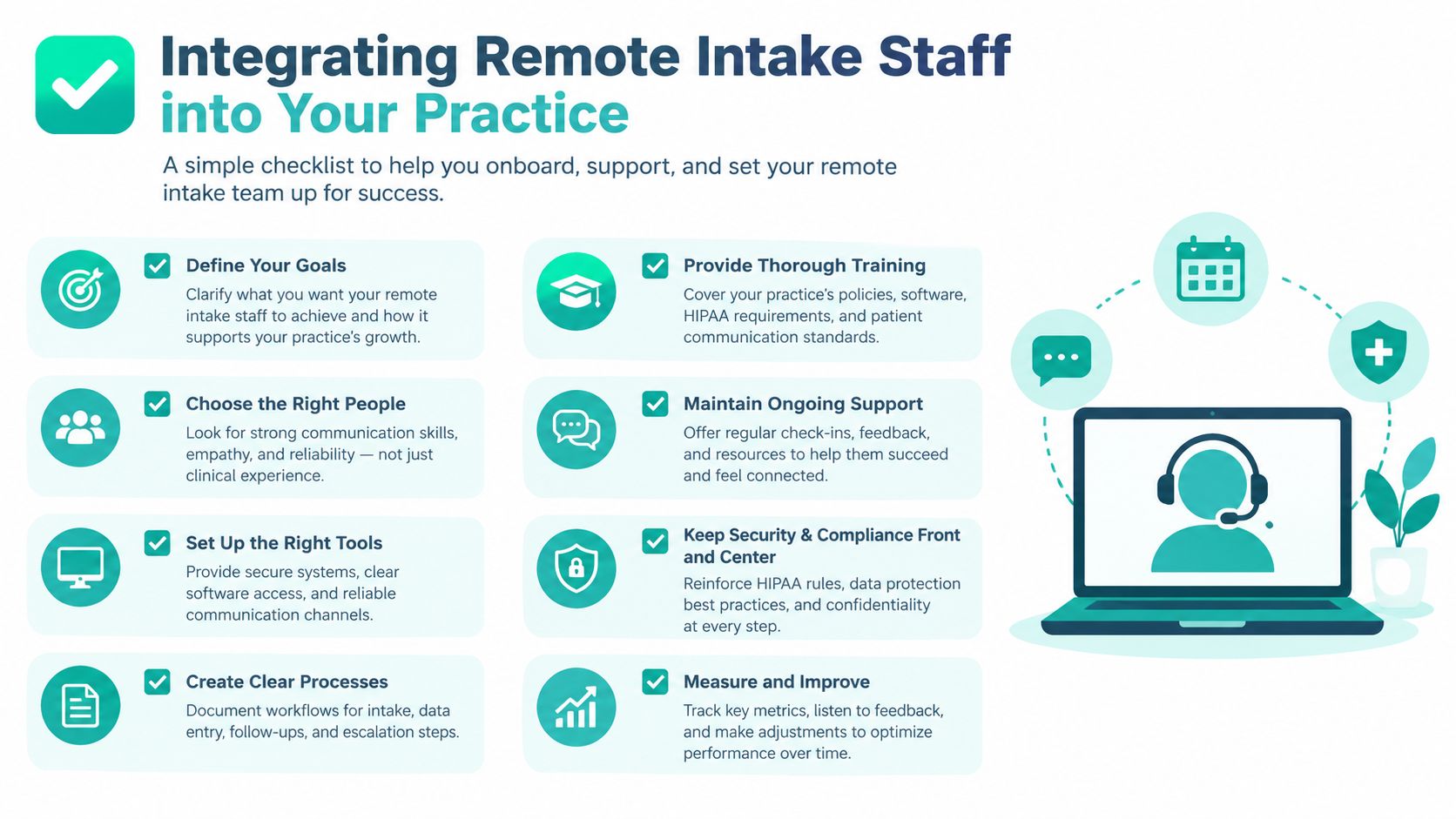
The first week should establish the operating system, not just introduce the new hire. Give the specialist a controlled path through the firm's tools, scripts, records, and escalation rules. Avoid granting broad access before you understand what the role requires.
Map the current intake path. Document every source, including phone, web forms, chat, email, referrals, and advertising platforms. Note who sees the inquiry first, where it is recorded, and where delays occur.
Write the qualification rules. Separate automatic disqualifiers, attorney-review conditions, urgent matters, conflict-related questions, and ordinary scheduling requests. The specialist should never have to invent the firm's standards during a live call.
Configure least-privilege access. Provide individual logins, multifactor authentication, approved devices, and access only to the systems and fields required for the role. HIPAA may apply to some law-firm workflows involving protected health information, but HIPAA compliance isn't established by calling a vendor or worker “HIPAA certified.” Review the firm's actual obligations with qualified counsel or a compliance professional.
Connect communication tools. Set up the approved VoIP, call queues, voicemail, SMS, email, and calendar permissions. If the firm uses RingCentral, test routing, transfers, recording rules, voicemail ownership, and after-hours behavior before the specialist handles live calls.
Run a supervised practice period. Use fictional scenarios and approved sample records first. Then review real interactions closely, especially qualification notes, follow-up tasks, escalation decisions, and language-specific communication.
Establish daily control points. A short start-of-day queue review, an escalation channel for urgent issues, and an end-of-day unresolved-lead report usually provide more control than constant monitoring.
A candidate may be excellent at reception but unsuitable for plaintiff intake, immigration qualification, or a practice with sensitive family-law inquiries. Use a role-specific assessment with a realistic call scenario, a written case note, a software task, and an escalation decision.
Review performance across several dimensions:
Secure operations also require a documented offboarding process. Remove access promptly when the assignment ends, recover firm equipment, preserve necessary records, and confirm that the worker knows how to handle any remaining confidential information.
A legal intake specialist is not just a person who answers the phone. The role manages the first operational stage of client acquisition by responding to inquiries, collecting facts, applying firm criteria, documenting the matter, following up, and booking the right next step. A receptionist, intake specialist, and case manager can work together, but they shouldn't be measured or trained as interchangeable roles.
The firms that benefit most from dedicated intake support treat speed, qualification accuracy, documentation, and escalation as a designed workflow. For personal injury, immigration, family, and other competitive practices, bilingual remote talent can add schedule coverage and language capability when the firm provides secure systems, clear boundaries, and active supervision.
Audit your current intake queue, identify where leads wait or disappear, and decide whether the gap requires reception coverage, a dedicated intake specialist, or downstream case-management support. Virtual Legal Assistants can help law firms evaluate that role and connect with pre-vetted bilingual remote professionals aligned to their software and schedule. Visit Virtual Legal Assistants to review the available staffing approach and start a role-specific conversation.